
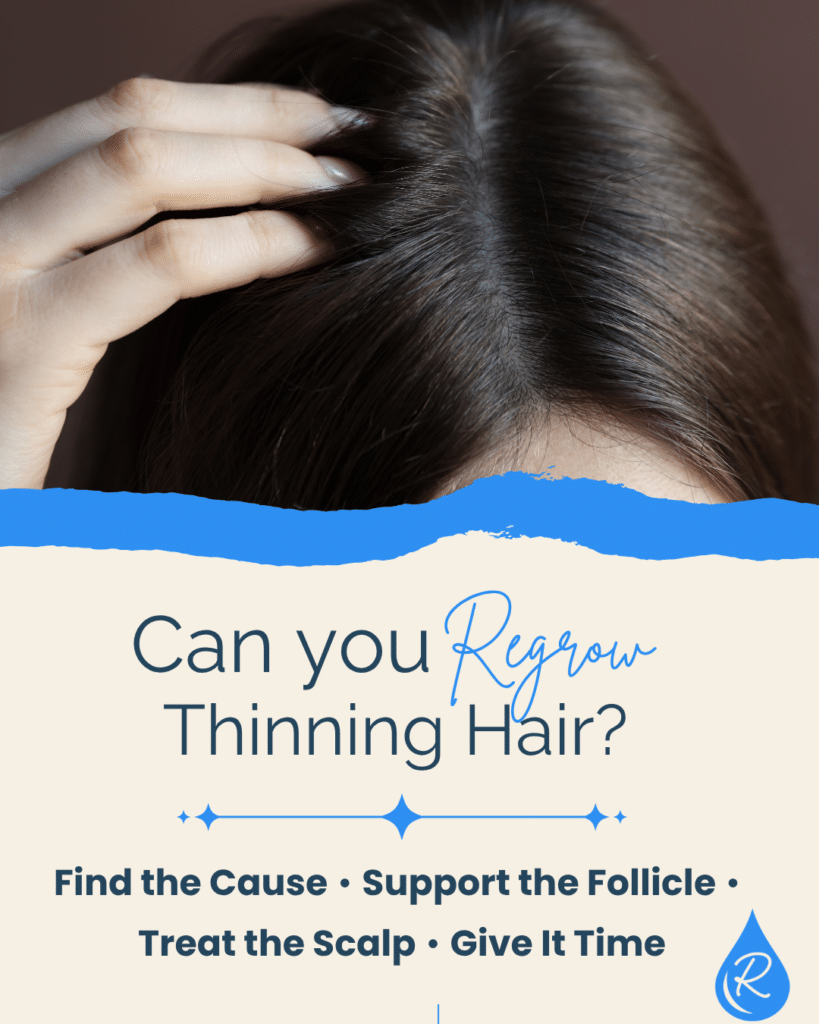
If you’ve noticed your ponytail getting smaller, your part looking wider, or more scalp showing through, you may be wondering: Can you regrow thinning hair?
Sometimes, yes.
But hair loss isn’t one single condition, and there isn’t one treatment that works for everyone.For some people, addressing the underlying cause can lead to significant improvement. For others, the goal may be to decrease shedding, strengthen and thicken existing hair, slow continued loss, and protect the follicles that are still healthy.
The most important part is figuring out why your hair is thinning before deciding what to do about it.
Start With the Cause
Hair thinning can happen for many different reasons, including:
- Hormonal changes
- Perimenopause and menopause
- Changes in testosterone and other hormones
- Genetics
- Thyroid dysfunction
- Iron or other nutritional deficiencies
- Significant or rapid weight loss
- Inadequate protein or calorie intake
- Illness or surgery
- Physical or emotional stress
- Certain medications
- Scalp conditions
- Age-related changes in the hair follicle
And sometimes it isn’t just one thing.
You might have a genetic tendency toward thinning hair and be going through a hormonal change. Or you may already have some age-related thinning and then experience increased shedding after significant weight loss.
That’s why we don’t think hair loss should automatically be treated with the same product or protocol for everyone.
Look at Nutrition
Hair isn’t essential for survival. When your body doesn’t have enough energy or nutrients to go around, growing thick, healthy hair isn’t necessarily its first priority.
This is particularly important during weight loss.
When appetite decreases, it can be surprisingly easy to eat too little protein or simply not consume enough overall nutrition. Significant or rapid weight loss itself can also trigger temporary increased shedding.
Protein should be a priority because hair is primarily made of keratin, a protein. Iron, zinc, vitamin D, B vitamins and other nutrients also play roles in normal hair growth and follicle function.
But more supplements aren’t automatically better.
When appropriate, evaluating nutrition and possible deficiencies can help determine whether something needs to be corrected rather than simply adding a handful of vitamins and hoping for the best.
Topical Hair and Scalp Support
The scalp is where the follicle lives, so it deserves some attention too.
A healthy scalp environment and consistent home care can support the hair-growth process, particularly when combined with treatments aimed at the underlying cause.
One option we use is DefenAge 150K Hair Follicle Serum, a topical cosmeceutical designed to support the scalp and improve the appearance of thinning hair. It can be incorporated into a daily hair-support routine without assuming that every person with thinning hair has the same underlying problem.
Depending on the individual, we may also consider prescription-compounded topical serums containing ingredients selected specifically for that patient’s type of hair loss and medical history.
This is where personalization becomes important. A topical product that makes sense for one person may not be the best choice for another.
Oral Supplements and Prescription Options
Sometimes support from the inside makes sense too.
Targeted oral hair supplements may provide nutrients and other ingredients that support normal hair growth, particularly when diet, increased nutritional needs, or other factors are part of the picture.
But we don’t believe every person with thinning hair automatically needs the same “hair vitamin.”
There are also prescription oral medications that may be considered for certain types of hair loss. The appropriate medication depends on whether the patient is male or female, age, hormonal status, medical history, medications, pregnancy potential and, most importantly, what appears to be driving the hair loss.
Prescription treatment isn’t right for everyone, but for the appropriate patient it can be another tool in a comprehensive hair-restoration plan.
Hormones May Be Part of the Picture
Hormonal changes can have a significant effect on hair.
Women may begin noticing changes during perimenopause or menopause as estrogen, progesterone and androgen balance shifts. Men can also experience progressive changes in hair density related to genetics, aging and androgen activity.
That doesn’t mean every case of thinning hair is a hormone problem — and it certainly doesn’t mean everyone needs hormone therapy.
It means hormones are one piece of the puzzle worth considering when symptoms and history point in that direction.
Regenerative Hair Treatments
For people who still have active but weakened or miniaturizing follicles, regenerative treatments may provide another way to support hair growth.
PRP Hair Restoration
Platelet-rich plasma, or PRP, uses a concentrated portion of your own blood containing platelets and growth factors. It is injected into targeted areas of the scalp to help support follicle function and the environment surrounding the hair follicle.
There is an important distinction here:
PRP doesn’t create brand-new hair follicles.
The goal is to stimulate and support follicles that are still present.
If a follicle is functioning but producing progressively thinner hairs, there may be an opportunity to improve its performance. If an area has been completely bald for many years and the follicles are no longer viable, expectations need to be very different.
PRP is generally performed as a series of treatments, and results develop gradually as the hair moves through its normal growth cycle.
Often, the Best Approach Is a Combination
Hair restoration doesn’t necessarily mean choosing between a serum, supplement, prescription, or PRP.
Depending on the cause, a plan might involve several strategies working together:
- Correcting nutritional deficiencies or inadequate protein intake
- Addressing hormonal or medical contributors when appropriate
- Improving scalp and hair care
- Using a cosmeceutical such as DefenAge 150K Hair Follicle Serum
- Using a customized prescription topical serum when appropriate
- Adding targeted oral supplements
- Considering prescription medication for appropriate patients
- Using PRP to support weakened follicles
Not everyone needs every step.
The goal is to choose the pieces that actually make sense for the individual.
Hair Growth Takes Time
This may be the hardest part of treating thinning hair: you have to give it time.
Hair grows in cycles. Even when a treatment is working, meaningful changes aren’t usually visible in a few weeks.
Sometimes the first improvement is simply noticing less hair in the shower or on your brush. Visible changes in thickness and density generally take several months, and continued improvement can take longer.
Consistent photos can be helpful because gradual changes are difficult to recognize when you look at your own hair every day.
Can Everyone Regrow thinning Hair?
No — and it’s important to be clear about that.
The likelihood of improvement depends on several factors:
- What is causing the hair loss
- How long it has been happening
- Whether the follicles are still active
- Genetics
- Nutrition and overall health
- Hormonal factors
- The treatments being used
- Consistency
- Time
For some people, success may mean noticeable regrowth. For others, it may mean decreasing shedding, thickening existing strands, slowing progression, or maintaining the hair they currently have.
Those are meaningful outcomes too.
Earlier Is Usually Better
One of the biggest mistakes people make with thinning hair is waiting until the loss becomes significant before doing anything about it.
If your part is widening, your hairline is changing, your scalp is becoming more visible, or you’re consistently noticing more shedding than usual, it may be worth investigating sooner rather than later.
At Rejuvenate Batesville, our approach to thinning hair starts with the bigger picture. We can look at factors such as nutrition, weight changes, hormones, overall wellness and your pattern of hair loss, then discuss options ranging from home hair and scalp support to oral supplements, prescription treatments and PRP hair restoration.
Because the goal isn’t to put everyone on the same hair-growth protocol.
It’s to figure out why your hair is thinning — and then decide what actually makes sense to help it.